
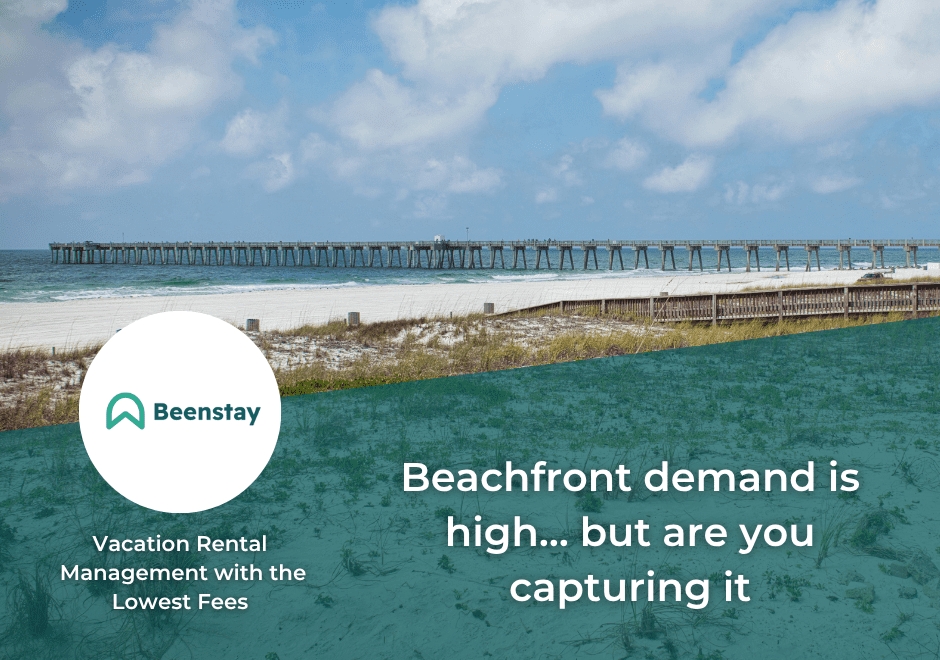
Vacation Home Management increases revenue fastest when operators align directly with beachfront demand signals instead of generic pricing rules. In Panama City Beach, 27 miles of coastline create one of the most predictable yet underutilized demand engines in the short-term rental market.
Most owners capture only surface-level demand. The top-performing properties extract an additional 20% to 45% revenue by positioning specifically around beach proximity, views, and access.
Why Beachfront Demand in Panama City Beach Drives Higher Revenue
Panama City Beach operates on layered demand, not just seasonal spikes. The combination of 320+ sunny days, drive-to traffic, and family tourism creates continuous booking pressure near the coast.
Beachfront and near-beach properties consistently outperform inland listings across every key metric.
Beachfront vs Inland Performance Gap
The difference is measurable and consistent:
- Beachfront and walkable properties earn 18% to 35% higher nightly rates
- Occupancy stays 10% to 20% higher across shoulder months
- Listings with ocean views see up to 25% higher click-through rates
- Properties beyond 1.5 miles from the beach drop 15% to 30% in booking frequency
This gap exists because guests filter for proximity first, then evaluate price.
Beachfront demand is not just stronger. It is prioritized.
What Vacation Home Management Means in a Coastal Market
Vacation Home Management in Panama City Beach is the active process of converting beachfront visibility into booked nights and higher revenue per stay.
This requires constant alignment with traveler behavior, not static listing management.
Core Systems That Capture Beachfront Demand
High-performing operators rely on:
- Dynamic pricing tied to weather, weekends, and local events
- Search-optimized listings focused on beach access and views
- Sub-10 minute response times to capture high-intent guests
- Review generation systems that maintain 4.7+ ratings
- Turnover operations built for same-day bookings
Listings that respond within 10 minutes increase booking conversion rates by up to 25%.
Speed matters more in beach markets because guests often compare multiple similar listings quickly.
How Pricing Strategy Leverages Beachfront Demand
Pricing in Panama City Beach must reflect micro-demand shifts tied to beach conditions, not just calendar seasons.
Most hosts underperform because they price for averages instead of peaks.
Beach Demand Pricing Benchmarks
- Peak season occupancy can exceed 85% with optimized pricing
- Shoulder season can hold 60% to 70% with strategic discounts
- Weekend rates near the beach can rise 25% to 45% above weekdays
- Ocean view premiums can add $50 to $120 per night
- Event and holiday surges can lift revenue by 20% to 35%
Operators who adjust pricing at least 3 times per week outperform static pricing models by up to 35% annually.
Beach demand fluctuates daily. Pricing must follow.
How Listing Positioning Converts Beach Traffic Into Bookings
Visibility alone does not drive revenue. Conversion happens when listings match how guests search for beach stays.
High-Converting Beachfront Listing Elements
- First image clearly shows beach proximity or ocean view
- Title includes terms like “walk to beach” or “ocean view”
- Description highlights exact distance to the shoreline
- Amenities emphasize balconies, beach gear, and outdoor space
Listings that clearly communicate beach access see up to 30% higher click-through rates and stronger booking intent.
Guests are not guessing. They are scanning for proof.
Guest Experience Premium in Beachfront Properties
Beachfront guests have higher expectations and higher willingness to pay.
This creates an opportunity to increase rates through experience, not just location.
What Drives Higher Ratings and Repeat Bookings
- Cleanliness scores above 4.8
- Frictionless check-in under 5 minutes
- Fast issue resolution within 1 hour
- Local recommendations for beaches, dining, and activities
Properties with ratings above 4.7 can increase nightly rates by 10% to 20% without reducing occupancy.
Better experience strengthens pricing power.
Operational Pressure in High Demand Coastal Markets
Panama City Beach has high turnover frequency, especially for 2 to 4 night stays.
This creates operational bottlenecks that directly impact revenue.
Critical Operational Benchmarks
- Turnover time under 5 hours
- Maintenance resolution within 24 hours
- Same-day booking readiness
- Response time under 10 minutes
Failure to meet these benchmarks can reduce occupancy by 15% to 25%.
In beach markets, small delays lead to lost bookings.
The Signature Insight: Demand Stacking Strategy
Top operators do not rely on one type of guest. They layer multiple demand segments across the same property.
This is how beachfront properties outperform even within the same location.
How Demand Stacking Works
- Weekdays target remote workers and short stays
- Weekends capture drive-in travelers
- Peak months focus on families and groups
- Off-season targets snowbirds with longer stays
This strategy increases annual occupancy by 10% to 18% while stabilizing revenue across slower months.
Beachfront demand becomes predictable when segmented correctly.
Common Mistakes That Kill Beachfront Revenue
Even strong locations underperform due to execution gaps.
High Impact Errors
- Pricing too low during high-demand beach days
- Failing to highlight ocean views in images
- Slow response times above 1 hour
- Ignoring guest feedback trends
- Weak cleaning systems that block same-day bookings
Each mistake can reduce total annual revenue by 10% to 40%.
Location creates opportunity. Execution determines results.
When to Shift to Professional Vacation Home Management
Self-managing works until operational complexity starts limiting growth.
Beachfront demand amplifies both upside and inefficiencies.
Clear Decision Triggers
- Occupancy stays below 65% in a high-demand area
- Pricing updates happen less than once per week
- Response times exceed 20 minutes
- Reviews fall below 4.6
- Management workload exceeds 15 hours per week
At this stage, missed revenue often exceeds management costs.
How Vacation Home Management Unlocks Full Beachfront Potential
Vacation Home Management aligns pricing, positioning, and operations with real-time beachfront demand.
Operators who execute this well increase revenue by 20% to 50% without changing the property itself.
This comes from:
- Better demand timing
- Stronger listing conversion
- Higher guest satisfaction
- Faster operational execution
Beachfront demand is already there. The advantage comes from capturing it fully.
Why Professional Management Changes Performance
Short-term rental management services bring structure to a fast-moving market. They apply pricing systems, optimize listings for beachfront conversion, and maintain operational consistency during high turnover periods.
Beenstay helps property owners increase revenue through real-time pricing, improve guest experience with proven systems, and simplify operations by handling day-to-day execution. This allows owners to fully leverage beachfront demand in Panama City Beach without operational overload.
Frequently Asked Questions
Beachfront and walkable properties typically earn 18% to 35% higher nightly rates and maintain 10% to 20% higher occupancy compared to inland listings.
High-performing listings update pricing at least 3 times per week. This can increase annual revenue by up to 35% compared to static pricing.
Properties with ratings above 4.7 can charge 10% to 20% more per night while maintaining strong occupancy levels.